
Blog Details
- Member
- January 1, 2026
Dialectical Storification as a Pedagogical Method
A Foundational Contribution of Srijan Sanchar
Introduction
Over the last two decades,
story-based pedagogy has gained global acceptance as a powerful means to
improve engagement, empathy, and contextual understanding in education.
However, most approaches treat story as a communication or engagement tool,
applied after knowledge has already been structured.
Srijan Sanchar introduced a
fundamentally different proposition:that
story itself can serve as the primary structure through which concepts are
organized, contested, and stabilized.
This methodology did not merely use stories
to explain concepts.It reconstructed the historical and conceptual conflicts
that gave rise to those concepts, enabling learners to experience knowledge
as a lived intellectual journey rather than as finished information.
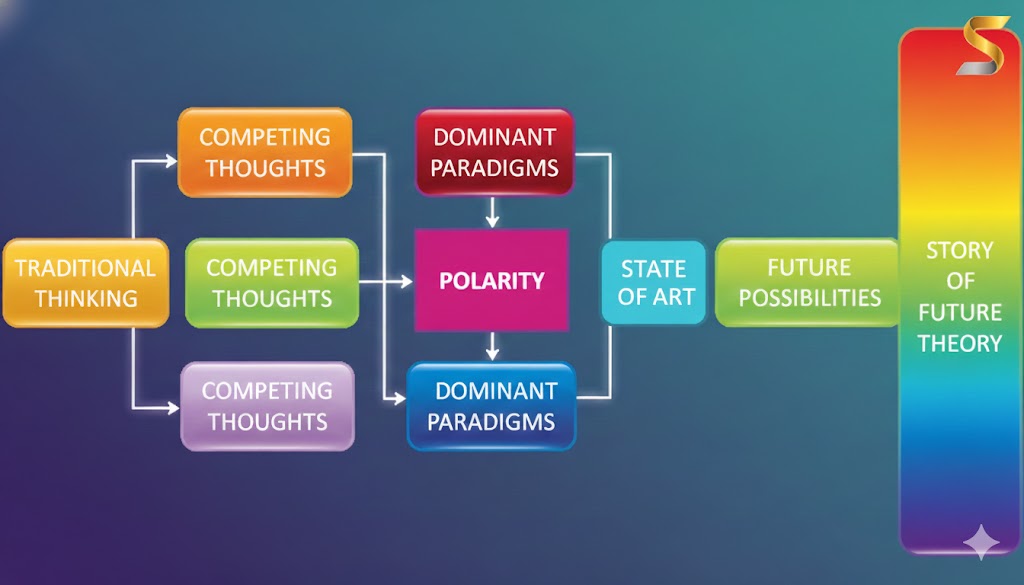
This document establishes that polarity-based structuring of concepts as
story as:
- A novel pedagogical method,
- A replicable and teachable framework,
- And a foundational epistemic architecture that
logically precedes later probabilistic models such as PCCN.
Significance
Summary
The polarity-based story methodology
of Srijan Sanchar is significant because it:
- Repositions knowledge as resolved conflict, not static fact
- Makes abstraction intelligible by re-humanizing its
origins
- Introduces rigor into storytelling, moving it beyond anecdote
- Works across disciplines, including science, mathematics, engineering, policy,
and ethics
- Trains learners in judgment, not just comprehension
- Anticipates modern systems thinking, complexity science, and probabilistic reasoning
Most importantly, it offers
something rare in global pedagogy:
A way to teach how knowledge became
true, not just what is currently accepted as true.
This alone qualifies it as a distinct
and recognisable pedagogy.
Core
Premise of the Methodology
The methodology rests on a simple
but powerful epistemic insight:
Every stable concept is the outcome
of a historical polarity.
Accepted ideas exist because:
- Earlier ways of thinking failed,
- Competing ideas challenged dominant assumptions,
- A synthesis became necessary, not merely
persuasive.
Therefore, deep learning requires
reliving this polarity.
The
Polarity-Based Story Methodology: Detailed Framework
Phase
1: Reversal of Instructional Time
(Starting from Conflict, Not
Conclusion)
Instead of beginning with established
definitions, the educator deliberately moves backward in time.
Learners are introduced to:
- The current dominant paradigm,
- Then guided to uncover the prior worldview that
once seemed complete, coherent, and unquestionable.
This phase answers:
“Why did the old explanation once
make sense—and why did it eventually fail?”
This reversal:
- Restores intellectual humility,
- Creates genuine curiosity,
- Establishes narrative stakes.
Phase
2: Identification of the Central Polarity
(Making the Invisible Tension
Explicit)
At the heart of every lesson, the
educator identifies a core polarity, such as:
- Determinism vs Uncertainty
- Continuity vs Disruption
- Efficiency vs Equity
- Safety vs Performance
- Authority vs Evidence
This polarity is not rhetorical—it
is structural.
It defines:
- What was at risk,
- What assumptions were being challenged,
- Why the conflict could not be ignored.
Phase
3: Mapping Concepts onto Narrative Roles
Concepts are then assigned
narrative functions:
|
Narrative
Role |
Epistemic
Role |
|
Proponent |
Carrier of emerging insight |
|
Dominant Paradigm |
Existing explanatory structure |
|
Resistance |
Institutional, cultural, or
cognitive inertia |
|
Conflict |
Logical incompatibility |
|
Resolution |
Conceptual synthesis |
This does not fictionalize
knowledge.
It reveals its human and logical struggle.
Phase
4: Storification of the Conceptual Struggle
The lesson is structured as a story
of ideas, with:
- An inciting intellectual crisis,
- Escalation through failed attempts and objections,
- A turning point where old logic collapses,
- A synthesis that resolves contradictions.
Crucially, synthesis is presented
as:
- Inevitable under constraints,
- Transformative rather than victorious,
- Provisional rather than absolute.
Phase
5: Nested Dialectics and Knowledge Lineage
A major innovation of this
methodology is the idea of nested polarity.
Here:
- Each synthesis becomes the starting point of the
next conflict,
- Knowledge is traced as a genealogy of ideas, not
isolated facts.
Learners begin to see:
- Paradigms as historically contingent,
- Progress as non-linear,
- Truth as evolving under pressure.
This directly prepares the ground
for probabilistic and systems-based thinking.
Why
This Is a Recognized Pedagogy (Not a Technique)
This polarity-based story
methodology qualifies as a pedagogy because it is:
- Systematic
– follows a repeatable structure
- Transferable
– applies across domains
- Cognitively deep
– builds mental models, not just memory
- Emotionally anchored
– integrates human struggle
- Ethically formative
– exposes consequences and trade-offs
Conclusion
Srijan Sanchar postulates
story as an epistemic structure
grounded in polarity and synthesis.
By enabling learners to experience
the necessity of ideas, not just their conclusions, this methodology
represents a foundational and original contribution to global story-based
pedagogy—one that deserves formal recognition, articulation, and adoption.